Sacramento Motorcycle Accident Lawyer

FREE EVALUATION (916) 777-7777

Why Choose Arnold Law Firm for Your Sacramento Motorcycle Accident Case

Motorcycle accident cases are not car accident cases on two wheels. Insurance companies approach them with a different playbook, one that starts with blaming the rider. The defendant says “I didn’t see the motorcycle.” The adjuster talks about lane splitting like it is reckless conduct rather than legal. The opening offer arrives low, with a comment about how juries are tough on motorcyclists. None of that is the law, and none of it is acceptable.

Arnold Law Firm has spent decades representing motorcyclists injured on Sacramento streets and highways. We understand California’s motorcycle-specific laws, the most common defense tactics in motorcycle litigation, and the evidence that disappears quickly after a crash. Our founder, Clay Arnold, is a member of the State Bar of California and the Sacramento County Bar Association. We handle every motorcycle accident case on a contingency fee basis, which means you pay nothing unless we recover compensation for you.

Three things you need to know about your case:

  • Lane splitting is legal in California. Vehicle Code § 21658.1 expressly authorizes it. Defendants and insurers cannot use it as a substitute for a real fault analysis.
  • “I didn’t see the motorcycle” is not a defense. A driver who fails to see what is plainly visible is the legal definition of negligence.
  • Time matters. Surveillance footage gets overwritten. Witnesses move. If the road or a public-entity vehicle was involved, the deadline to present a claim is six months, not two years.

Call (916) 777-7777 for a free, no-obligation case evaluation, or request an evaluation online.

"*" indicates required fields

Address*
SMS*
This field is for validation purposes and should be left unchanged.

What to Do After a Sacramento Motorcycle Accident

The steps you take in the first hours after a motorcycle crash directly affect whether you recover full compensation, partial compensation, or nothing at all. This is even more true in motorcycle cases than in car accident cases because injuries tend to be more severe, evidence disappears faster, and defense lawyers begin building their fault-the-rider story immediately.

If you are physically able, do the following:

  1. Call 911 and accept emergency medical care. Motorcycle crashes routinely cause internal injuries and traumatic brain injuries that you do not feel at the scene. Decline emergency transport only if you have a clear-headed reason; if you have any doubt, accept it. A documented chain of medical treatment is also one of the strongest things in your case.
  2. Get a police report. Make sure officers respond. Note the responding officers’ names and the incident number. A police report at the scene, even if it contains errors you later have to correct, is much more useful than a report taken hours later by phone.
  3. Document the scene if it is safe. Photograph the vehicles, the position of your motorcycle, the road surface, any debris, all visible damage, license plates, and the other driver’s insurance card. If road conditions contributed (pothole, gravel, oil slick), photograph those before they are cleared.
  4. Identify witnesses. Get names and phone numbers of anyone who saw the crash. Witnesses to motorcycle crashes are often pedestrians or other drivers who leave the scene once police arrive.
  5. Do not talk to the other driver’s insurance company. An adjuster will likely call you within 24 to 48 hours, often before you have even left the hospital, asking for a recorded statement. You are not required to give one. Decline politely and tell them your attorney will be in contact.
  6. Preserve your gear and the motorcycle. Do not have your motorcycle repaired or junked before an attorney has evaluated whether mechanical inspection is needed. Keep your helmet, riding gear, and any damaged equipment in the same condition they were after the crash.
  7. Contact an attorney as soon as possible. Surveillance footage at gas stations, businesses, and traffic intersections is typically overwritten within 30 to 90 days. If a public entity was involved (road defect, government vehicle, government employee on duty), there is a six-month deadline to present a written government claim under Government Code § 911.2. That clock runs while you are still in treatment.

If you did not follow all these steps, do not panic. Contact an attorney before any further communication with the insurance company and we will build the case from the facts as they stand.

"*" indicates required fields

Address*
SMS*
This field is for validation purposes and should be left unchanged.

What Is Your Sacramento Motorcycle Accident Case Worth?

The honest answer is that we cannot give you a number without first understanding your injuries, the available insurance coverage, the strength of liability evidence, and the likely defense theory. What we can tell you is the framework California law provides for valuing your case.

Economic Damages

California Civil Code §§ 3281 and 3333 entitle you to recover the full financial detriment caused by another’s wrongful act. That includes past and future medical expenses, lost wages, lost future earning capacity, and property damage. Future damages are recoverable when they are reasonably certain to occur. Cal. Civ. Code § 3283. Life care planners, treating physicians, vocational experts, and economists are standard in serious motorcycle cases.

One important note on medical specials: under Howell v. Hamilton Meats & Provisions, Inc., 52 Cal.4th 541 (2011), recovery of past medical expenses is generally limited to the amounts actually paid or owed to providers under negotiated rates, not the full amounts billed. Corenbaum v. Lampkin, 215 Cal.App.4th 1308 (2013), applied the same rule to billed amounts as evidence of future medical costs.

Non-Economic Damages

Non-economic damages compensate for what the injury actually does to your life: pain, suffering, mental anguish, disfigurement, physical impairment, and loss of enjoyment of life. California does not cap non-economic damages in ordinary motor vehicle cases. The medical malpractice cap under Cal. Civ. Code § 3333.2 does not apply to motorcycle accidents.

Non-economic damages typically make up a larger proportion of motorcycle case awards than auto case awards. The reason is straightforward: motorcyclists have no protective shell, so when something goes wrong, the injuries tend to be catastrophic. Permanent scarring, chronic pain, mobility loss, and the inability to ride or work as you did before are the kinds of harm California juries take seriously.

Punitive Damages

Punitive damages may be available where the defendant acted with malice, oppression, or fraud, proven by clear and convincing evidence. Cal. Civ. Code § 3294. In motorcycle cases, the most common basis is a defendant who was driving under the influence. The California Supreme Court has held that voluntarily driving while intoxicated demonstrates the conscious disregard for safety that supports punitive damages. Taylor v. Superior Court, 24 Cal.3d 890 (1979).

For our analysis of California punitive damages generally, see our blog post on punitive damages.

California Deadlines That Apply to Your Motorcycle Accident Case

Motorcycle accident cases run on multiple clocks. If you miss any of them, you can lose the right to recover even if your case is otherwise strong.

The Two-Year Personal Injury Deadline

California Code of Civil Procedure § 335.1 requires personal injury lawsuits to be filed within two years of the date of the injury. For most motorcycle cases the clock starts on the date of the crash. In limited circumstances, the discovery rule may delay accrual until a plaintiff knows or has reason to know of the injury and its negligent cause. Rivas v. Safety-Kleen Corp., 98 Cal.App.4th 218 (2002). Two years is the maximum; in many cases there are shorter deadlines that take precedence.

The Six-Month Government Claim Deadline

This is the one that catches people. If your motorcycle crash involved a road defect (pothole, deteriorating pavement, gravel left on a curve, water or oil on the roadway), a government employee operating a vehicle on duty, a government-owned truck, or a hazard the public entity should have removed, you must present a written claim to the responsible public entity within six months of the date of injury. Cal. Gov. Code § 911.2. The entity has 45 days to act on the claim, after which it is deemed rejected. Cal. Gov. Code § 912.4. Once the claim is rejected (in writing or by inaction), you have six months from the date written rejection notice is delivered to file suit; without written rejection notice, two years from accrual. Cal. Gov. Code § 945.6.

Recent California Supreme Court authority confirms the strength of road-defect claims against public entities. In Whitehead v. City of Oakland, S284303 (May 1, 2025), the Court held unanimously that a public entity cannot use a pre-injury liability waiver to escape its statutory duty to maintain safe public roads. The case involved a cyclist who hit an obscured pothole on a charity ride after signing a waiver. The Court ruled that Civil Code § 1668 prohibits waivers that excuse violations of statutory duty. Whitehead joins established authority such as Williams v. County of Sonoma, 55 Cal.App.5th 125 (2020), in establishing that public entities are accountable for dangerous road conditions.

Minors and Tolling

Code of Civil Procedure § 352 tolls the statute of limitations for minors during the time they are under the age of majority. There is a critical exception: tolling under § 352 does not apply to claims against a public entity or public employee that require government claim presentation. A child injured by a road defect or government-owned vehicle is subject to the six-month government claim deadline regardless of age. A parent or guardian must act within that period.

What This Means in Practice

If a public entity is potentially involved in your crash, do not wait. The two-year deadline is irrelevant when the six-month government claim deadline runs first. The same is true if you are still in treatment. The deadline runs from the date of injury, not the date you finish treatment or reach maximum medical improvement.

WE FIGHT FOR YOUR MAXIMUM INJURY COMPENSATION

California Motorcycle Law: What Every Sacramento Rider Should Know About a Personal Injury Case

California’s statutory framework for motorcycle operation is more developed than most states’, and several provisions have direct consequences for how a motorcycle accident case is litigated. Understanding the relevant law is essential to recognizing when the defense is making a real argument and when it is just bluster.

Lane Splitting Is Legal: Vehicle Code § 21658.1

California is the only state that has expressly codified lane splitting at the state-statute level. Vehicle Code § 21658.1, effective January 1, 2017, defines lane splitting as “driving a motorcycle that has two wheels in contact with the ground, between rows of stopped or moving vehicles in the same lane, including on both divided and undivided streets, roads, or highways.” The statute also authorizes the California Highway Patrol to develop and publish educational guidelines.

What lane splitting being legal means in litigation: a defendant cannot argue that the fact of lane splitting was itself wrongful or negligent. The only question is whether the specific lane-splitting maneuver, in context, was done with reasonable care. A motorcyclist filtering through stopped traffic at low speed in normal commute conditions is doing something lawful and expected; an insurer’s attempt to portray it as reckless is a tactic, not a legal argument.

The Helmet Law and Damages: Vehicle Code §§ 27802 and 27803

California requires drivers and passengers on motorcycles, motor-driven cycles, and motorized bicycles to wear a safety helmet that meets the standards set under § 27802. The DMV’s implementing regulations require compliance with Federal Motor Vehicle Safety Standard No. 218 (49 C.F.R. § 571.218), and helmets must be conspicuously labeled with the manufacturer’s certification of federal compliance.

The question of how helmet non-use or non-compliance affects damages is more nuanced than some sources suggest. California has not enacted a statutory helmet-defense provision comparable to the seatbelt-defense provision in Vehicle Code § 27315(j). At the same time, California has not categorically barred all evidence relating to helmet use either. The case law on safety-equipment non-use, including the California Supreme Court’s decision in Horn v. General Motors Corp., 17 Cal.3d 359 (1976), reflects courts’ historical reluctance to allow broad comparative-fault reductions based on a plaintiff’s failure to wear safety equipment. The seatbelt-defense framework was later modified by statute (§ 27315(j)) for seatbelt cases; no parallel statute exists for motorcycle helmets.

In practice, defendants in motorcycle cases sometimes attempt to introduce evidence that a rider’s failure to wear a compliant helmet was a substantial factor in causing or aggravating specific head injuries. Whether such evidence is admissible turns on the specific factual record, including expert testimony on whether a helmet would actually have prevented the particular injury sustained. The California Supreme Court’s discussion in Clemente v. State of California, 40 Cal.3d 202 (1985), illustrates the kind of causation evidence courts require. The takeaway is that helmet evidence is not an automatic blanket reduction, but it is also not an automatic exclusion. The fight is on the specific facts.

Motorcycle Licensing: Vehicle Code § 12804.9

California issues two motorcycle license classes. Class M1 authorizes operation of any two-wheel motorcycle or motor-driven cycle. Class M2 is more limited, authorizing motorized bicycles, mopeds, and motor-driven cycles. A rider with an M1 endorsement may operate any vehicle in the M2 category without additional examination. Applicants under 21 must complete a California Motorcyclist Safety Program novice course to obtain either endorsement.

Equipment Requirements That Come Up in Litigation

Vehicle Code § 27801 sets handlebar height limits (hands on grips no more than six inches above shoulder height). Section 27800 requires a properly secured rear seat and footrests for any passenger. Sections 25650 and 25650.5 require functioning headlamps and, for motorcycles built after January 1, 1978, automatic headlamp activation when the engine starts.

California’s Minimum Auto Insurance: Vehicle Code § 16451

Effective January 1, 2025, California’s minimum auto liability coverage requirements increased to $30,000 per person, $60,000 per accident, and $15,000 in property damage. These minimums apply equally to drivers of cars and motorcycles, since motorcycles are “motor vehicles” under California law. Voris v. Pacific Indem. Co., 213 Cal.App.2d 29 (1963). A further increase to $50,000/$100,000/$25,000 is scheduled for January 1, 2035.

The relevance for motorcycle cases is significant. Even with the increased minimums, the policy limits available from an at-fault driver who carries only minimum coverage are usually not enough to cover serious motorcycle injuries. Identifying additional sources of coverage is one of the most important things a motorcycle attorney does early in a case.

Uninsured and Underinsured Motorist Coverage

Your own UM/UIM coverage is often the most important source of compensation in a motorcycle case where the at-fault driver carried only minimum policy limits or no insurance at all. Insurance Code § 11580.2 governs UM/UIM bodily-injury coverage in California. In hit-and-run cases involving bodily injury, the statute generally requires three things: actual physical contact between the insured and the unidentified vehicle, a police report within 24 hours of the accident, and a sworn statement to the insurer within 30 days. A separate property-damage UM provision, Insurance Code § 11580.26, has its own structure (including a 10-business-day reporting requirement for property damage). Insurance Code § 11580.23 separately addresses notice requirements in actions filed against an uninsured motorist.

Whether your case fits the physical contact requirement turns on the specific facts. The California courts have construed “physical contact” relatively broadly. In Pham v. Allstate Insurance Co., 206 Cal.App.3d 1193 (1988), the court held that the contact requirement is met when an object carried or thrown by a vehicle strikes the insured. The deadlines for police reporting and the sworn statement are strict, however, and we strongly encourage anyone in a hit-and-run scenario to involve law enforcement immediately and consult an attorney without delay.

Howell and Medical Specials

The California Supreme Court’s decision in Howell v. Hamilton Meats & Provisions, Inc., 52 Cal.4th 541 (2011), limits recovery of past medical expenses to the amounts actually paid or accepted in satisfaction of those bills, rather than the gross amounts billed. Corenbaum v. Lampkin, 215 Cal.App.4th 1308 (2013), extended that limitation to evidence of future medical specials. This matters for case valuation: the “amount billed” number is not the recoverable number, and a competent attorney works with the actual paid amounts.

Conspicuity and Comparative Fault

Insurers in motorcycle cases routinely raise “conspicuity” arguments: the motorcyclist was wearing dark clothing, was in a blind spot, was lane splitting, was at a relative speed differential, or otherwise was not as visible as the defendant thinks they should have been. Under California’s pure comparative fault rule from Li v. Yellow Cab Co., 13 Cal.3d 804 (1975), any percentage of fault assigned to the rider reduces the recovery, but does not bar it. The fight in most motorcycle cases is over allocation: an experienced motorcycle attorney challenges each conspicuity argument with the legal duty of the other driver to look out for what is plainly visible, the actual facts of the lookout (was the defendant on a phone, was their view actually obstructed, did they have prior similar near-misses), and expert testimony where appropriate.

"*" indicates required fields

Address*
SMS*
This field is for validation purposes and should be left unchanged.

Common Sacramento Motorcycle Accident Scenarios and Who Is Liable

Most motorcycle accidents fall into a small number of recognizable patterns. The legal framework for each pattern is well established, and so are the defense tactics insurers use to shift blame to the rider.

Left-Turn Crashes

The single most common serious motorcycle accident pattern is a vehicle turning left across a motorcyclist’s path of travel. California Vehicle Code § 21801 requires a left-turning driver to yield the right of way to oncoming vehicles close enough to constitute a hazard, and to continue yielding until the turn can be completed with reasonable safety. That duty applies lane by lane. A driver who receives a wave-through from one lane cannot assume the other lanes are clear. Gilmer v. Ellington, 159 Cal.App.4th 190 (2008). The continuing duty to look for oncoming vehicles during the turn cannot be discharged by a single glance. Sesler v. Ghumman, 219 Cal.App.3d 218 (1990).

Defendants in left-turn motorcycle cases frequently say “I didn’t see the motorcycle.” That statement is not a defense. Negligence is the failure to exercise reasonable care, and a driver’s duty to look includes a duty to actually see what is plainly visible.

Lane Change and Blind Spot Crashes

Vehicle Code § 22107 requires a driver changing lanes to make the movement only when it can be done with reasonable safety and to signal the change whenever another vehicle could be affected. The signaling duty applies to potential effect on another vehicle, not just actual impact. People v. Logsdon, 164 Cal.App.4th 741 (2008). Violations of § 22107 typically support a negligence per se theory in lane-change motorcycle cases.

Insurers in lane-change cases often raise a “conspicuity” defense, arguing the motorcyclist’s clothing, lane position, or absence of high-visibility gear contributed to the driver’s failure to see them. California law evaluates this through ordinary comparative-fault principles. The defendant still has the duty to check before changing lanes. A failed lookout is not excused by the rider’s choice of jacket color.

Dooring

Vehicle Code § 22517 prohibits opening a vehicle door on the side available to moving traffic unless it is reasonably safe to do so. The duty rests on the person opening the door, who must check for approaching traffic including motorcyclists and bicyclists. Dooring crashes typically cause serious injuries because the rider is thrown over the door at speed.

Road Defects and Public Entity Liability

Motorcycles are more vulnerable than cars to roadway hazards. A pothole, a patch of gravel, a slick of leaked oil, or standing water can throw a rider in conditions where a four-wheeled vehicle would simply roll through. Government Code § 835 makes a public entity liable for injury caused by a dangerous condition of its property where the plaintiff proves the property was in a dangerous condition at the time of the injury, the dangerous condition created a reasonably foreseeable risk of the kind of injury suffered, the dangerous condition proximately caused the injury, and either a negligent employee act created the condition or the entity had actual or constructive notice with sufficient time to remedy it. Williams v. County of Sonoma, 55 Cal.App.5th 125 (2020).

The 2025 California Supreme Court decision in Whitehead v. City of Oakland, S284303, strengthens these claims significantly: a public entity cannot use a pre-injury liability waiver to escape its statutory road-maintenance duty. Pothole and road-defect cases against Caltrans, Sacramento County, the City of Sacramento, or other public entities are subject to the six-month government claim deadline. Do not wait.

Rear-End and Following Too Closely

Vehicle Code § 21703 requires drivers to maintain a reasonable and prudent following distance. In rear-end motorcycle cases, this duty is heightened by the relatively small visual profile of a motorcycle and the rider’s vulnerability to even a low-speed collision from behind.

Impaired Driver Crashes

When the at-fault driver was under the influence, the case typically supports both compensatory and punitive damages. Cal. Civ. Code § 3294; Taylor v. Superior Court, 24 Cal.3d 890 (1979). Sacramento County’s heavy traffic and substantial nightlife footprint generate a steady flow of motorcycle injury cases involving impaired drivers.

Common Injuries in Sacramento Motorcycle Accident Cases

A motorcyclist hit by a passenger car or truck has no airbag, no crumple zone, and no metal shell to absorb the impact. The protection is whatever the rider is wearing. The result is that even moderate-speed collisions cause serious or catastrophic injuries, and the typical injury severity in motorcycle cases is significantly higher than in standard auto cases.

Traumatic Brain Injuries

Even a DOT-compliant helmet does not eliminate the risk of brain injury in a high-force collision. Concussions, contusions, and severe traumatic brain injuries are common in motorcycle cases and can affect cognition, memory, personality, and physical function for years or permanently. Learn more about Sacramento TBI cases.

Spinal Cord Injuries

Spinal cord compression, fracture, and severing are common in motorcycle collisions. Outcomes range from chronic pain and limited mobility to permanent paralysis requiring lifetime care, mobility equipment, and home modifications. Learn more about Sacramento spinal cord injury cases.

Orthopedic Injuries

Multiple fractures (femur, tibia, pelvis, ankle, wrist) are routine in motorcycle accidents. Many require surgical repair with plates, rods, or screws. Recovery can take months or years and frequently involves permanent loss of range of motion or strength. Compound fractures, where the bone breaks through the skin, carry infection risk and longer recovery timelines.

Road Rash and Skin Injuries

What sounds like a minor abrasion can be far worse. Severe road rash often requires skin grafts, multiple surgeries, and leaves permanent scarring. Disfigurement is recoverable as part of non-economic damages and can substantially affect case value.

Internal Injuries

High-impact collisions cause blunt force trauma to organs, internal bleeding, and abdominal injuries that may not produce immediate symptoms. Delayed diagnosis is common and can be life-threatening. This is one of the reasons we tell riders to accept emergency care even when they feel functional at the scene.

Amputations and Crush Injuries

When a passenger vehicle pins a motorcyclist or its parts crush an extremity, the result can be traumatic amputation or a crush injury requiring later surgical amputation. These cases involve lifetime prosthetic care, home and vehicle modifications, and substantial future medical costs.

Burns

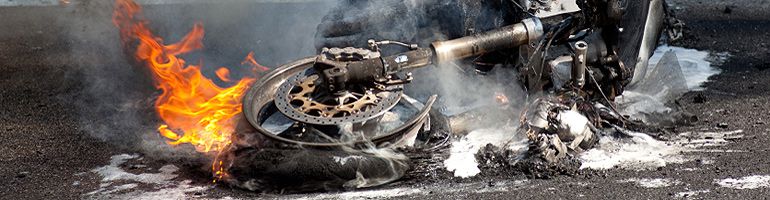
Fuel tank ruptures and post-collision fires cause burns requiring multiple surgeries, extended hospitalization, and frequently resulting in permanent scarring and disfigurement.

Wrongful Death

Because of the physics of motorcycle collisions, fatal outcomes are unfortunately common. When a family member is killed in a motorcycle accident, eligible family members may pursue a wrongful death claim under Cal. Civ. Proc. Code §§ 377.60 and 377.61, recovering for the financial support the decedent would have provided, the value of household services, and the loss of love, companionship, comfort, care, and guidance. A separate survival action under Cal. Civ. Proc. Code §§ 377.30 and 377.34 may recover the decedent’s pre-death economic losses. Note that the temporary exception to the survival-action rule permitting recovery of decedent pre-death pain and suffering applies only to qualifying actions filed before January 1, 2026; that exception has expired. Learn more about California wrongful death cases.

The severity of injuries in motorcycle cases means total damages, including future medical care and lifetime impact, frequently reach into seven and eight figures. We work with life care planners, medical experts, and economists to fully document what you have lost and will need going forward. Learn more about catastrophic injury cases.

"*" indicates required fields

Address*
SMS*
This field is for validation purposes and should be left unchanged.

Frequently Asked Questions About Sacramento Motorcycle Accident Cases

Is lane splitting legal in California?

Yes. California Vehicle Code § 21658.1, effective January 1, 2017, expressly authorizes lane splitting. California is the only state with statutory authorization at the state level. Lane splitting cannot be used as evidence of negligence simply because the maneuver occurred; the only question is whether the specific maneuver was conducted with reasonable care.

What if I was not wearing a helmet?

California Vehicle Code § 27803 requires riders and passengers to wear a DOT-compliant helmet. If you were not wearing one, defendants may attempt to introduce evidence that the absence of a helmet contributed to or aggravated specific injuries, particularly head injuries. Whether such evidence is admissible turns on the specific facts and expert testimony about whether a helmet would actually have prevented the injury you sustained. California has not enacted a categorical helmet-defense statute equivalent to the seatbelt-defense rule. Helmet status does not bar your case; it may affect damages allocation depending on what the evidence actually shows.

The other driver said “I didn’t see the motorcycle.” Is that a defense?

No. The duty of every driver includes the duty to look for and see what is plainly visible. A statement that the driver “didn’t see” you is, at most, an admission that they failed to maintain a proper lookout. In left-turn cases, the duty applies lane by lane and continues throughout the turn. Sesler v. Ghumman, 219 Cal.App.3d 218 (1990); Gilmer v. Ellington, 159 Cal.App.4th 190 (2008).

I hit a pothole on Highway 50 (or another state road). Can I sue?

Possibly. Public entities can be liable for road defects under Government Code § 835 when the defect created a substantial risk of foreseeable injury and the entity had notice. A critical deadline applies: you must present a written claim to the entity within six months of the date of injury under Government Code § 911.2. The recent California Supreme Court case Whitehead v. City of Oakland, S284303 (May 1, 2025), strengthened these claims by holding that public entities cannot use pre-injury liability waivers to escape their statutory duty to maintain safe roads. Contact an attorney quickly if a road defect is involved.

The driver who hit me was not insured. Can I still recover?

Yes, in most cases. Your own UM/UIM coverage under Insurance Code § 11580.2 typically provides bodily injury coverage when the at-fault driver was uninsured or fled the scene. Hit-and-run cases generally require physical contact between you and the unidentified vehicle, a police report within 24 hours, and a sworn statement to your insurer within 30 days. These deadlines are strict, so report immediately and consult an attorney.

How much is my motorcycle accident case worth?

Case value depends on the severity and permanence of your injuries, your medical specials and lost income, the strength of liability evidence, the available insurance coverage and policy limits, the level of fault contested or established, and whether punitive damages apply. We will not give you a number based on a phone call. We will give you an honest assessment after reviewing your medical records, the police report, and any available evidence.

How long will my case take?

Cases with clear liability and completed treatment can sometimes resolve within several months of a properly assembled demand. Cases requiring expert witnesses, contested liability, or government claim presentation typically take longer. If we file suit in Sacramento County Superior Court, the litigation timeline is generally 12 to 24 months from filing to resolution.

What does it cost to hire Arnold Law Firm for a motorcycle accident case?

Nothing up front. We handle every motorcycle case on a contingency fee basis, which means we collect a fee only if we recover compensation for you. Your initial case evaluation is free.

Sacramento Areas We Serve

Arnold Law Firm represents motorcycle accident victims throughout the Sacramento region, including downtown Sacramento, Midtown, Natomas, North Sacramento, South Sacramento, Rancho Cordova, and Elk Grove, as well as surrounding cities including Roseville, Rocklin, Folsom, Citrus Heights, West Sacramento, and Davis.

Sacramento and its surrounding areas have well-known motorcycle accident concentrations on Interstate 5, Interstate 80, US-50, Highway 99, and the Capital City Freeway, where high-speed traffic flow combines with commuter congestion. Surface street accidents are common at the major intersections in Midtown, on Sunrise Boulevard and Madison Avenue in Citrus Heights and Fair Oaks, on Folsom Boulevard, and in the commercial corridors of Rancho Cordova and Elk Grove.

Contact Our Sacramento Motorcycle Accident Lawyers Today

If you or a family member was injured in a Sacramento motorcycle accident, time matters. Surveillance footage gets overwritten. Witnesses become hard to find. If a public entity was potentially involved, the six-month government claim deadline is already running. Call Arnold Law Firm at (916) 777-7777 for a free, no-obligation case evaluation. We will review the facts, explain your options in plain language, and tell you honestly whether we believe we can help.

We work on a contingency fee basis. You pay nothing unless we recover compensation for you.

LATEST NEWS

Industrial chemical storage tank with emergency response equipment, illustrating the Garden Grove methyl methacrylate leak incident

Garden Grove Methyl Methacrylate Leak at GKN Aerospace: Legal Rights for Evacuated Residents

May 24, 2026 UPDATE: Significant developments since this article was first published See “Major Developments Since the Leak Began” below for details. More than 50,000 Orange County residents have been ordered out of their homes since Thursday afternoon after a 34,000-gallon storage tank at the GKN Aerospace facility in Garden Grove began leaking methyl methacrylate, a highly flammable, toxic industrial chemical. Orange County Fire Authority officials have publicly warned that the compromised tank is expected to fail and may explode. If you live, work, attend school, or own a business inside the evacuation zone, you may be entitled to compensation for the costs and harms you have already incurred, and for those still to come. This page explains, in plain

Treble Damages in California Trucking Cases

California law provides a specific statutory remedy for victims injured by impaired commercial vehicle drivers when their employers fail to meet federal safety requirements. Understanding when treble damages apply—and how they differ from standard punitive damages—is crucial for truck accident victims seeking maximum compensation. What Are Treble Damages? Treble damages allow injured parties to recover three times their actual damages under specific legal circumstances. In California trucking cases, this remedy is narrowly defined and differs significantly from general punitive damages available in other personal injury cases. California Civil Code § 3333.7: Statutory Treble Damages Requirements for Recovery Under California Civil Code § 3333.7, injured parties may recover treble damages from a commercial motor vehicle driver’s employer when all of the

California Trucking Accidents: Standards of Care

California law establishes different standards of care for trucking operations depending on the type of service provided. While most commercial trucking companies transporting freight are subject to ordinary negligence standards, federal motor carrier safety regulations impose enhanced duties that can significantly affect liability in truck accident cases. Key Takeaways: Commercial carriers of goods generally DO NOT have the duty of “utmost care” Federal Motor Carrier Safety Regulations (FMCSRs) DO create heightened standards in specific situations Large truck drivers must exercise greater caution than ordinary motorists Licensed motor carriers have nondelegable safety duties Common Carrier Standard: When Does “Utmost Care” Apply? The Enhanced Duty for Passenger Transportation California Civil Code section 2100 requires carriers of persons for reward to use “the

Settlement - $3,900,000

Car Accident

The fatal collision between plaintiff’s Jeep Liberty and defendant’s Volvo truck left Ryan Eisenbrandt’s surviving wife and parents with a judgment of $3.9 million, but the defendant’s insurance company refused to pay. This resulted in a second, intense legal battle between Plaintiffs and Defendant’s insurance company.

During the pendency of the wrongful death case, Defendant’s insurance company had filed a federal court action to rescind the defendants $1,000,000 insurance policy, claiming that defendant had made misrepresentations when applying for that policy. Initially, the federal court agreed with the insurance company, granting summary judgment that effectively denied recovery to the Eisenbrandts given the defendant was otherwise insolvent. The Arnold firm and the Eisenbrandts refused to accept this unfair outcome. They appealed the federal judge’s ruling to the Ninth Circuit Court of Appeals. The Ninth Circuit reversed the lower court and sent the case back to the same federal judge for a trial on the merits.

Christine Doyle of the Arnold Firm tried the case in February 2011 in front of the same judge who had previously thrown out the Eisenbrandt’s case. A unanimous advisory jury and the trial judge, after hearing the true facts about the insurance company’s effort to avoid responsibility, found in the Eisenbrandts favor. After four years of fighting for what is right, the insurance company was ordered to pay up.

Settlement - $8,000,000

Truck Accident

Morgan Stanley Class Action Data Breach Settlement Attained by the Arnold Law Firm

Late one spring afternoon, the Arnold Law Firm received a call from Angela, a young mother of three. She was calling from the hospital where her husband Christopher had been air-lifted for treatment of severe injuries from a tragic motor vehicle accident earlier that day. Angela’s mother, a past client of our firm, had encouraged her to give us a call.

As it turns out, Angela’s prompt contact with us was a very important decision for their family. Immediate representation allowed our team to secure critical evidence right away — appropriate storage and analysis of the vehicle to avoid tampering, timely professional photography of the scene, and interviews of involved parties — which ended up being imperative to the details of Christopher’s case.

A commercial vehicle had failed to stop at a rural stop-sign intersection, colliding with the compact sedan driven by Christopher, an active 33-year-old father. The impact caused extensive damage to his spinal cord in the cervical area. Despite multiple surgeries, rehabilitation programs for physical and psychological therapy, and in-home care, his injuries rendered him a paraplegic, paralyzed from the mid-chest. In an instant, life as he had known it was gone forever.

At the time of the accident, the at-fault driver of the commercial vehicle was acting within the scope of his employment with a large corporation. With the employer being directly liable, as such, defense counsel fought hard to minimize Christopher’s damages, claiming that his being unemployed at that time devalued his losses. Our legal team made sure Christopher’s true losses were represented, including his potential income, his options and mobility, his ability to provide for and support his family, and the lifetime of care he now needed. Christopher’s injuries also dramatically affected his spouse’s daily life, resulting in a claim on her behalf.

Furthermore, the extent of Christopher’s injuries were, in part, due to defects involving the dual-restraint system in his own vehicle. Despite the manufacturer’s efforts to deny any responsibility, the Arnold Law Firm established negligence relevant to his case.

The result was a settlement of $8 million — the largest pre-trial settlement for this type of case in the region. Christopher now has the resources to receive the ongoing care he now requires, improve the quality of his life and take care of his young family.

Verdict - $10,200,000

Motorcycle Accident

The Arnold Law Firm is pleased to report that our attorneys received a $10.2 million verdict handed down in Modesto. Defense counsel was Kevin Cholakian of San Francisco. The defense rejected a 998 within the $1 million policy limits three years ago. The highest defense offer was $350k.

The case involved a blind corner dirt fire road collision between a truck driven by the defendant and a motorcycle driven by the plaintiff Dan Nixon. THe plaintiff had no recollection of the collision. The defendant claimed that the plaintiff had too much speed for the corner and lost control. The plaintiff’s son (who identified the wrong curve in discovery) claimed that the defendant was on the wrong side of the curve, causing his dad to make an unsuccessful emergency maneuver. The jury assessed 70% fault to the defendant and 30% to plaintiff.

The plaintiff, now 50-years-old, suffered a dislocated right knee with popliteal artery rupture which has left him with an unstable knee, and permanently damaged lower leg. Because of vascular damage he is not a candidate for knee reconstruction or replacement. The plaintiff’s treating doctors testified that he will require an above knee amputation within 20 years. Past lost wages were $78,000 and past medicals were $570,000. The jury awarded $7.5 million in general damages (3 m. past and 4.5 m. future) as well as all future economic damages asked for by the plaintiff. The jury deliberated for 3 and a half hours.

Settlement - $17,000,000

Data Breach

Infinity/Kemper Class Action Data Breach Settlement Attained by the Arnold Law Firm

The Arnold Law Firm, along with co-counsel at Morgan & Morgan, and Mason, Lietz, & Klinger, and Wolf, Haldenstein, Adler, Freeman, & Herz LLP, reached a settlement in the Kemper and Infinity data breach class action lawsuit, also known as Irma Carrera et al. v. Kemper Corporation and Infinity Insurance Company, filed in the United States District Court Northern District of Illinois, Case No. 1:20-cv-01883. The settlement is valued at over $17 million.

The Honorable Judge Martha M. Pacold granted Preliminary Approval of the settlement on October 27, 2021.

In addition to substantial injunctive relief, the class members will receive access to Aura’s Financial Shield Services for a period of 18 months, up to $10,000 for reimbursement of documented out-of-pocket losses reasonably traceable to the Data Breach, up to 3 hours of time spent remedying issues related to the breach at $18 per hour, and $50 for Class Members who are California residents.

History of the data breach: On April 8, 2021, the Arnold Law Firm and Wolf, Haldenstein, Adler, Freeman, & Herz LLP filed the first class action complaint against Kemper and Infinity in the United States District Court for the Northern District of Illinois entitled Irma Carrera Aguallo et al. v. Kemper Corporation and Infinity Insurance Company, Case No. 1:21-cv-01883. The complaint asserted claims against Defendants for: (1) negligence; (2) negligence per se, (3) violation of California’s Unfair Competition Law, Cal. Bus. & Prof. Code § 17200, et seq. – Unlawful Business Practices, (4) violation of California’s Unfair Competition Law, Cal. Bus. & Prof. Code § 17200, et seq. – Unfair Business Practices, (5) violation of the California Consumer Privacy Act (“CCPA”), Cal. Civ. Code § 1798.100, et seq., (6) violation of California’s Consumers Legal Remedies Act, Cal. Civ. Code § 1750, et seq., (7) violation of Florida’s Deceptive and Unfair Trade Practices Act, Florida Statute § 501.201, et seq., (8) breach of implied contract, (9) declaratory judgment, and (10) unjust enrichment arising from the data breach.

Settlement - $18,276,000

Qui Tam / Whistleblower

Whistleblowers Represented by Arnold Law Firm Expose Fraudulent Practices by the Pill Club, Case Settled With California DOJ

The Arnold Law Firm and the Hirst Law Group represented two whistleblowers who helped expose fraudulent practices by a start-up online pharmacy company called The Pill Club.

The company allegedly used fraudulent practices to bill California’s Medicaid program, Medi-Cal, for their services. The Pill Club is also alleged to have violated state laws by allowing nurse practitioners to prescribe contraceptive products to women without proper supervision or training from a licensed medical doctor.

For their part in blowing the whistle on the company they worked for, and as part of California Qui Tam laws, the whistleblowers and their attorneys recovered $4.9 million from the $18.275 million settlement paid to the California Department of Justice (DOJ) and the California Department of Insurance (CDI).

Settlement - $60,000,000

Data Breach

Morgan Stanley Class Action Data Breach Settlement Attained by the Arnold Law Firm

The Arnold Law Firm, along with co-counsel at Morgan & Morgan, Nussbaum Law Group, P.C. and others, reached a settlement in the Morgan Stanley data breach class action lawsuit, also known as In re Morgan Stanley Data Security Litigation, filed in the United States District Court Southern District of New York, Case No. 1:20-cv-05914-AT. The settlement resulted in a $60 million settlement fund to benefit class members.

The Motion for Preliminary Approval was filed on December 31, 2021 with the Honorable Judge Analisa Torres.

In addition to substantial injunctive relief, the 15 million class members will be provided access to Aura’s Financial Shield services for at least two years, which includes a $1 million insurance policy protecting each subscriber, credit monitoring, identity freezing, dark web monitoring, income tax protection and more services. The fund will also provide payments to people who submit valid claims for out-of-pocket expenses and/or up to four hours of lost-time incurred as a result of the data breach. Lost time allows victims of the data breach to be paid at $25 per hour for up to four hours of attested time spent dealing with the data breach. Out-of-pocket expenses can be claimed up to $10,000 if the costs or expenditures are fairly traceable to the data breach.

History of the data breach: On July 29, 2020, the Arnold Law Firm and Morgan & Morgan filed the first class action lawsuit against Morgan Stanley in the United States District Court for the Southern District of New York entitled Sylvia Tillman et al. v. Morgan Stanley Smith Barney, LLC., Case No. 1:20-cv-05914. The complaint asserted claims against Defendants for: (1) negligence; (2) invasion of privacy; (3) negligence per se; (4) unjust enrichment; (5) violation of the California Unfair Competition Law, Cal. Bus. & Prof. Code § 17200, et seq. – Unlawful Business Practices; and (6) violation of California’s Unfair Competition Law, Cal. Bus. & Prof. Code § 17200, et seq. – Unfair Business Practices.

Settlement - $3,767,000

Truck Accident

A 20-year-old man who had been married for just 12 days left home on his way to work. He was driving on Pleasant Grove Road in Sutter County in the early morning when he came upon a slow-moving truck. As he pulled out to pass the truck, the truck driver turned left in front of him. The young man attempted to steer back into his lane but his vehicle struck an un-flagged piece of metal extending from the back of the truck. He died in the resulting crash.

Expert witnesses brought in by the Arnold Law Firm proved that the truck, owned and operated by a hauling firm, should never have been on the highway that morning. Specifically, the rear and side turn signals did not work and the rear-view mirror was in a poor state of adjustment at the time of the collision. As a result, the driver, who had failed to properly inspect the vehicle before setting out that morning, couldn’t see the young man’s vehicle as it attempted to pass.

The poor condition of the truck, its lack of maintenance and the manner in which it was operated were found to be substantial factors in causing the collision that killed the young man. The testimony also established that the man had been making a lawful pass at the lawful speed limit and acted reasonably when he attempted to avoid the collision.

The man’s 20-year-old widow was awarded $3,767,000.77, his parents were awarded $185,131 and the family was reimbursed $11,899 in funeral expenses. Though money is a poor substitute for a young man’s life, this verdict demonstrates that drivers who endanger the lives of others will be held accountable for their actions.