Sacramento Rear-End Accident Lawyer

FREE EVALUATION (916) 777-7777

Each year, there are over 2 million rear-end collisions that occur in the United States. When a motor vehicle hits the car directly in front of it, the accident is considered a rear-end collision. Rear-end crashes are one of the most common types of auto accidents. Its generally easy to prove fault in a rear-end collision; however, it can sometimes be difficult to prove that an individuals injuries were caused by the accident.

If you have been injured or experienced property damage from a rear-end collision, you may have legal recourse. Contact the Sacramento car accident lawyers at the Arnold Firm to explore your legal options.

To receive a Free Case Review, complete the contact form on this page.

"*" indicates required fields

Address*
SMS*
This field is for validation purposes and should be left unchanged.

What Should You Do After a Rear-End Collision in Sacramento?

If you’ve just been rear-ended in Sacramento, taking the right actions early on can make a real difference. Here’s what to do, in order:

Step 1: Check for injuries and call 911: If there’s any injury—or even if you’re unsure—call 911. Emergency responders can help at the scene and document what happened, which may be important later.

Step 2: Move to a safer location: If your car still runs and it’s safe to do so, pull over to the shoulder or another area out of traffic. Move your car out of traffic, if it’s safe. If your vehicle still works and you’re not hurt, try to pull over somewhere out of the way. Staying in traffic puts you and others at risk of getting hit again.

Step 3: Document the scene: Take photos of the accident—both cars, any damage, the street, nearby signs, and anything else that shows what happened. Trade insurance and contact info with the other driver, and if anyone saw the crash, ask for their name and number.

Step 4: Seek medical attention: Even if you feel fine, it’s smart to get examined soon after. Some injuries take hours or days to show up, especially soft tissue ones like whiplash.

Step 5: Contact a Sacramento rear-end accident lawyer: Before dealing with the insurance company, speak to an experienced attorney who handles rear-end collisions. A lawyer can walk you through your rights and help you go after full compensation.

"*" indicates required fields

Address*
SMS*
This field is for validation purposes and should be left unchanged.

Causes of Rear-End Crashes

A sudden change in speed is often a contributing factor in rear-end accidents. When a driver quickly stops or slows down, it leaves the motorist behind them with little time to react.

Oftentimes, these accidents are caused by an inattentive driver; although, rear-end crashes can be caused by a variety of factors. Common causes of rear-end collisions include:

  • Exceeding the post speed limit
  • Reckless driving
  • Drivers under the influence
  • Tailgating
  • Motorists using their cell phone while driving
  • Drivers who fail to obey traffic laws

Common Injuries in Rear-End Collisions

Even though rear-end crashes occur at low speeds, it is not uncommon for the driver and passengers in the car that was hit to sustain injuries. Accident victims may suffer from the injuries listed below:

  • Whiplash
  • Soft tissue injuries
  • Head and face injuries from an airbag deployment
  • Wrist injuries from bracing the steering wheel
  • Knee and ankle injuries

When two vehicles in a rear-end collision are similar in size, they will generally experience the same amount of damage. However, if one car is larger than another, the smaller vehicle will experience the brunt of the damage.

When one vehicle is larger than the other in a rear-end crash, serious injuries can occur. Severe injuries that are often associated with rear-end accidents are:

  • Spinal cord injuries
  • Head injuries
  • Brain injuries
  • Nerve damage
  • Neck and back injuries

Injury symptoms sometimes may not be apparent immediately after a wreck, so its important to see a medical professional following an accident to make sure that you don’t have any hidden injuries. If an accident victim does not see a physician following a rear-end crash and later experiences signs of an injury, it may be difficult for a lawyer to prove that the injuries caused by the collision.

WE FIGHT FOR YOUR MAXIMUM INJURY COMPENSATION

How Long Does a Rear-End Collision Settlement Take?

There’s no set timeline, but most rear-end cases in California wrap up within a few months. If the injuries are minor and both sides agree on fault, it can be settled fairly quickly—sometimes in just a few weeks. More complicated cases, especially those with serious injuries or disputes about who is at fault in a rear-end collision in California, usually take longer.

What slows things down? Ongoing medical treatment, questions about fault, and back-and-forth negotiations with insurers. If your doctor is still figuring out the full extent of your injuries, the claim may need to wait. That’s normal—and often better than settling too early for less than you deserve.

Try to be patient. A rushed rear-end collision settlement in California might leave money on the table. Taking the time to get a full picture of your injuries and costs gives you a better shot at a fair result. A lawyer can help move things along without cutting corners.

Proving Negligence in a Rear-End Collision

Negligence means someone wasn’t being careful enough, or was being reckless behind the wheel. In a California rear-end crash, that could mean the back driver was texting, following too closely, speeding, or just not paying attention.  

As we mentioned, proving negligence in a rear-end car accident depends heavily on the evidence. Photos from the scene, dashcam or traffic cam footage, vehicle damage, police reports, and statements from witnesses can all help show what went wrong. Sometimes, property damage or skid marks on the road can back up your version of events.

Getting all of this together takes work. A rear-end collision lawyer in Sacramento can step in to request footage, talk to witnesses, and deal with the insurance company. They know how to present the details in a way that makes it clear who caused the accident. That kind of help can make all the difference when you’re trying to get a fair outcome.

How a Sacramento Rear-End Accident Lawyer Can Help

Getting rear-ended can turn your day upside down. Between the damage, injuries, and dealing with insurance, it’s a lot to manage. A lawyer helps by stepping in early and handling what needs to get done.

Looking Into What Happened

The first step is figuring out exactly how the crash unfolded. Your lawyer will review the accident from every angle, even if the situation is more complex—like a multi-car pileup—they may bring in experts to help break it down. All of this helps show who was at fault and why.

Dealing With The Insurance Company for You

Once the facts are clear, your lawyer handles the back-and-forth with the insurance company. That includes fighting back if they try to pin some of the blame on you or offer a low settlement. A solid claim includes more than just repair bills—it also covers your medical treatment, lost wages, and how the accident disrupted your life.

Taking the Case to Court if Needed

If the insurance company won’t settle fairly, your lawyer can take the case to court. It’s not always necessary, but it’s wise to have someone who’s ready and willing if it comes to that. With a Sacramento rear-end accident lawyer in your corner, you don’t have to deal with the legal system alone. You’ve got someone focused on getting you a better outcome—whether that means a fair settlement or a strong case in court.

Why Choose Arnold Law Firm?

When you’re dealing with the aftermath of a rear-end collision, you want a law firm that knows what it’s doing—and knows Sacramento. Here’s what sets Arnold Law Firm apart:

  • Decades of Experience: We’ve handled car accident and personal injury cases across California for years. We know what it takes to build a strong case and get real results.
  • Local Knowledge Matters: Our team understands how Sacramento courts work and how local insurance companies operate. That insight helps us move your case forward more efficiently.
  • Focused on You: We don’t treat clients like numbers. From day one, we listen, answer your questions, and make sure you feel supported through every step.
  • Proven Results: Our firm has recovered millions for accident victims. We’re not afraid to take on tough cases—and win.
  • No Upfront Costs: We offer free consultations, and you don’t pay us unless we win your case.

When you’re ready to take the next step, we’re here to make the process as straightforward as possible. We’ll explain your options, answer your questions, and fight to get you the outcome you deserve. You don’t have to go through this alone—reach out and let us help.

"*" indicates required fields

Address*
SMS*
This field is for validation purposes and should be left unchanged.

What Is the Rear-End Collision Law in California?

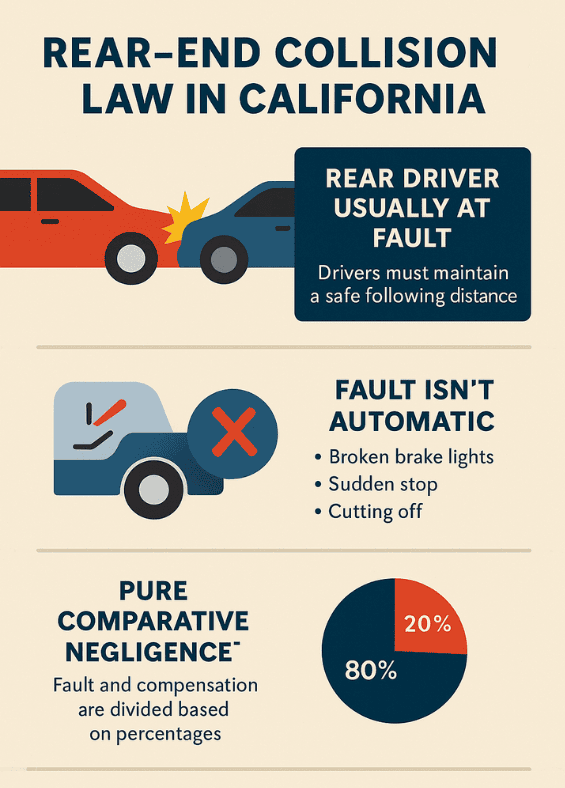
In California, when one car rear-ends another, the driver in the back is typically considered at fault. That’s because drivers are expected to maintain a safe following distance and stay alert to changing traffic conditions. If you didn’t stop in time, the law often views it as a failure to uphold that responsibility.

However, fault isn’t automatic. If the lead driver had broken brake lights, stopped suddenly without reason, or cut you off, those factors can shift liability. The details matter—and in some cases, the rear driver isn’t solely to blame.

California follows the pure comparative negligence rule, which means that, even if one driver caused most of the crash, the other driver’s mistakes get audited too. If both people were partly at fault, the compensation they can recover gets reduced by their share of the blame.

For example, if the front driver was 20% responsible for having bad brake lights, their settlement would be cut by 20%. Every accident is different, and little things can change how fault gets divided.

Rear-end crashes seem simple, but under California law, it’s not always clear-cut. You can’t just assume the rear driver is fully responsible. Fault and compensation depend on all the facts coming out after a full investigation.

Who Is at Fault in a 2-Car Rear-End Collision in California?

As stated, in most two-car rear-end accidents in California, the driver in the back is typically considered at fault. The law expects drivers to keep a safe distance and react in time to whatever happens ahead.

Sometimes the driver in front can share some of the blame. If they slammed on the brakes without warning, had broken brake lights, or swerved into another lane dangerously, the situation changes. In scenarios like that, fault might not stay with the driver behind.

The outcome depends on the evidence. Pictures from the scene, dashcam recordings, and witnesses who saw what happened can all play a part. Without something solid to show what went wrong, it’s harder to challenge the idea that the rear driver was responsible.

Who Is at Fault in a 3-Car Rear-End Collision in California?

In a three-car rear-end crash, fault often falls on more than one driver. California law looks closely at what each driver did before the collision happened.

These chain-reaction accidents usually start when the last car in line fails to stop in time. In a three-car pile up, the middle driver often gets shoved into the car in front. If they were leaving enough space, they might not be blamed at all. But if they were riding too close or looking at their phone, they could still share some of the fault.

Each case also depends on what the evidence shows—photos, skid marks, dashcam footage, or witness accounts. Sorting out who’s responsible isn’t simple in crashes with multiple cars involved. If you’ve been caught in a pile-up, it’s important to contact a lawyer who understands how fault works under California’s multi-car accident laws.

How Much Is the Average Settlement for a Rear-End Collision in California?

There’s no simple answer when it comes to the average settlement for a rear-end collision in California. They vary depending on the severity of the injuries and how much you’ve had to deal with afterward. 

Several factors play into how much a settlement ends up being:

  • Injury Severity: The more serious the injury, the higher the settlement. Minor injuries generally lead to smaller settlements, but serious injuries, especially those requiring surgeries or long-term treatment, tend to bring larger settlements.
  • Medical Bills: This is one of the biggest factors. If you need extensive medical treatment, the settlement will account for these costs. 
  • Lost Wages: If you had to miss work due to the accident or if your ability to work was affected, the settlement should cover that lost income. 
  • Pain and Suffering: It’s hard to put a number on pain, but it still plays a role in settlements. Long-lasting physical or emotional pain can significantly increase the settlement value.
  • Long-Term Effects: Sometimes injuries don’t just heal in a few weeks or months. If an injury impacts your life for years, that can be taken into account in the settlement.

How Do I Get a Settlement After Being Rear-Ended?

Start by getting checked by a physician. Even if you feel okay, it’s worth seeing a doctor—some injuries don’t show up right away. Keep copies of your bills, visit summaries, and anything else related to your care.

If you’re able, take a few photos after the collision—your car, the other one, where it happened. Jot down what you remember while it’s still clear. Keep any bills, missed work notes, or anything that shows what this has cost you.

Eventually, you’ll need to go through the claims process with insurance. That usually means sending a demand letter that explains what happened, how you got hurt, and what it’s all cost you.

A rear-end car accident attorney can help make sure everything’s lined up and push back if the insurance company tries to offer too little. That way, you’ve got someone in your corner who knows the system.

As we mentioned, the amount of money you receive from a claim usually comes down to things like medical costs, missed time at work, or pain that doesn’t go away. Every case is different.

Consulting with an experienced lawyer early on can help. They know what to look for and can make sure the insurance company doesn’t offer you an unfair amount.

"*" indicates required fields

Address*
SMS*
This field is for validation purposes and should be left unchanged.

Contact Our Rear-End Collision Attorneys Today!

If you were rear-ended in Sacramento, don’t wait to get the help you need. At Arnold Law Firm, we know how to handle these cases—and we’re ready to get to work for you. Our attorneys have years of experience fighting for people who’ve been injured in rear-end accidents, and we know what it takes to deal with insurance companies and win fair compensation.

Arnold Law Firm has the knowledge and resources to successfully litigate rear-end collisions. You won’t pay anything up front, and we only get paid if we recover money for you. It’s that simple. Schedule your free consultation today and let our team guide you through the process. We’re here to help you move forward and heal. You can also call (916) 777-7777 to get in touch directly with our car accident lawyers.

LATEST NEWS

Treble Damages in California Trucking Cases

California law provides a specific statutory remedy for victims injured by impaired commercial vehicle drivers when their employers fail to meet federal safety requirements. Understanding when treble damages apply—and how they differ from standard punitive damages—is crucial for truck accident victims seeking maximum compensation. What Are Treble Damages? Treble damages allow injured parties to recover three times their actual damages under specific legal circumstances. In California trucking cases, this remedy is narrowly defined and differs significantly from general punitive damages available in other personal injury cases. California Civil Code § 3333.7: Statutory Treble Damages Requirements for Recovery Under California Civil Code § 3333.7, injured parties may recover treble damages from a commercial motor vehicle driver’s employer when all of the

California Trucking Accidents: Standards of Care

California law establishes different standards of care for trucking operations depending on the type of service provided. While most commercial trucking companies transporting freight are subject to ordinary negligence standards, federal motor carrier safety regulations impose enhanced duties that can significantly affect liability in truck accident cases. Key Takeaways: Commercial carriers of goods generally DO NOT have the duty of “utmost care” Federal Motor Carrier Safety Regulations (FMCSRs) DO create heightened standards in specific situations Large truck drivers must exercise greater caution than ordinary motorists Licensed motor carriers have nondelegable safety duties Common Carrier Standard: When Does “Utmost Care” Apply? The Enhanced Duty for Passenger Transportation California Civil Code section 2100 requires carriers of persons for reward to use “the

Punitive Damages in California Personal Injury Cases

What Are Punitive Damages? Punitive damages are extra money a court can order a wrongdoer to pay, on top of the money that compensates an injured person for medical bills, lost wages, and pain and suffering. The main goal of punitive damages is not to repay the victim, but to punish especially bad behavior and to discourage similar conduct in the future. Think of punitive damages as a financial penalty for conduct that is much worse than ordinary carelessness. In California, punitive damages are not common. They are reserved for cases where the defendant’s conduct is particularly harmful, intentional, or shows a conscious disregard for the safety or rights of others. Most personal injury cases involve simple negligence (for example,

Settlement - $3,900,000

Car Accident

The fatal collision between plaintiff’s Jeep Liberty and defendant’s Volvo truck left Ryan Eisenbrandt’s surviving wife and parents with a judgment of $3.9 million, but the defendant’s insurance company refused to pay. This resulted in a second, intense legal battle between Plaintiffs and Defendant’s insurance company.

During the pendency of the wrongful death case, Defendant’s insurance company had filed a federal court action to rescind the defendants $1,000,000 insurance policy, claiming that defendant had made misrepresentations when applying for that policy. Initially, the federal court agreed with the insurance company, granting summary judgment that effectively denied recovery to the Eisenbrandts given the defendant was otherwise insolvent. The Arnold firm and the Eisenbrandts refused to accept this unfair outcome. They appealed the federal judge’s ruling to the Ninth Circuit Court of Appeals. The Ninth Circuit reversed the lower court and sent the case back to the same federal judge for a trial on the merits.

Christine Doyle of the Arnold Firm tried the case in February 2011 in front of the same judge who had previously thrown out the Eisenbrandt’s case. A unanimous advisory jury and the trial judge, after hearing the true facts about the insurance company’s effort to avoid responsibility, found in the Eisenbrandts favor. After four years of fighting for what is right, the insurance company was ordered to pay up.

Settlement - $8,000,000

Truck Accident

Morgan Stanley Class Action Data Breach Settlement Attained by the Arnold Law Firm

Late one spring afternoon, the Arnold Law Firm received a call from Angela, a young mother of three. She was calling from the hospital where her husband Christopher had been air-lifted for treatment of severe injuries from a tragic motor vehicle accident earlier that day. Angela’s mother, a past client of our firm, had encouraged her to give us a call.

As it turns out, Angela’s prompt contact with us was a very important decision for their family. Immediate representation allowed our team to secure critical evidence right away — appropriate storage and analysis of the vehicle to avoid tampering, timely professional photography of the scene, and interviews of involved parties — which ended up being imperative to the details of Christopher’s case.

A commercial vehicle had failed to stop at a rural stop-sign intersection, colliding with the compact sedan driven by Christopher, an active 33-year-old father. The impact caused extensive damage to his spinal cord in the cervical area. Despite multiple surgeries, rehabilitation programs for physical and psychological therapy, and in-home care, his injuries rendered him a paraplegic, paralyzed from the mid-chest. In an instant, life as he had known it was gone forever.

At the time of the accident, the at-fault driver of the commercial vehicle was acting within the scope of his employment with a large corporation. With the employer being directly liable, as such, defense counsel fought hard to minimize Christopher’s damages, claiming that his being unemployed at that time devalued his losses. Our legal team made sure Christopher’s true losses were represented, including his potential income, his options and mobility, his ability to provide for and support his family, and the lifetime of care he now needed. Christopher’s injuries also dramatically affected his spouse’s daily life, resulting in a claim on her behalf.

Furthermore, the extent of Christopher’s injuries were, in part, due to defects involving the dual-restraint system in his own vehicle. Despite the manufacturer’s efforts to deny any responsibility, the Arnold Law Firm established negligence relevant to his case.

The result was a settlement of $8 million — the largest pre-trial settlement for this type of case in the region. Christopher now has the resources to receive the ongoing care he now requires, improve the quality of his life and take care of his young family.

Verdict - $10,200,000

Motorcycle Accident

The Arnold Law Firm is pleased to report that our attorneys received a $10.2 million verdict handed down in Modesto. Defense counsel was Kevin Cholakian of San Francisco. The defense rejected a 998 within the $1 million policy limits three years ago. The highest defense offer was $350k.

The case involved a blind corner dirt fire road collision between a truck driven by the defendant and a motorcycle driven by the plaintiff Dan Nixon. THe plaintiff had no recollection of the collision. The defendant claimed that the plaintiff had too much speed for the corner and lost control. The plaintiff’s son (who identified the wrong curve in discovery) claimed that the defendant was on the wrong side of the curve, causing his dad to make an unsuccessful emergency maneuver. The jury assessed 70% fault to the defendant and 30% to plaintiff.

The plaintiff, now 50-years-old, suffered a dislocated right knee with popliteal artery rupture which has left him with an unstable knee, and permanently damaged lower leg. Because of vascular damage he is not a candidate for knee reconstruction or replacement. The plaintiff’s treating doctors testified that he will require an above knee amputation within 20 years. Past lost wages were $78,000 and past medicals were $570,000. The jury awarded $7.5 million in general damages (3 m. past and 4.5 m. future) as well as all future economic damages asked for by the plaintiff. The jury deliberated for 3 and a half hours.

Settlement - $17,000,000

Data Breach

Infinity/Kemper Class Action Data Breach Settlement Attained by the Arnold Law Firm

The Arnold Law Firm, along with co-counsel at Morgan & Morgan, and Mason, Lietz, & Klinger, and Wolf, Haldenstein, Adler, Freeman, & Herz LLP, reached a settlement in the Kemper and Infinity data breach class action lawsuit, also known as Irma Carrera et al. v. Kemper Corporation and Infinity Insurance Company, filed in the United States District Court Northern District of Illinois, Case No. 1:20-cv-01883. The settlement is valued at over $17 million.

The Honorable Judge Martha M. Pacold granted Preliminary Approval of the settlement on October 27, 2021.

In addition to substantial injunctive relief, the class members will receive access to Aura’s Financial Shield Services for a period of 18 months, up to $10,000 for reimbursement of documented out-of-pocket losses reasonably traceable to the Data Breach, up to 3 hours of time spent remedying issues related to the breach at $18 per hour, and $50 for Class Members who are California residents.

History of the data breach: On April 8, 2021, the Arnold Law Firm and Wolf, Haldenstein, Adler, Freeman, & Herz LLP filed the first class action complaint against Kemper and Infinity in the United States District Court for the Northern District of Illinois entitled Irma Carrera Aguallo et al. v. Kemper Corporation and Infinity Insurance Company, Case No. 1:21-cv-01883. The complaint asserted claims against Defendants for: (1) negligence; (2) negligence per se, (3) violation of California’s Unfair Competition Law, Cal. Bus. & Prof. Code § 17200, et seq. – Unlawful Business Practices, (4) violation of California’s Unfair Competition Law, Cal. Bus. & Prof. Code § 17200, et seq. – Unfair Business Practices, (5) violation of the California Consumer Privacy Act (“CCPA”), Cal. Civ. Code § 1798.100, et seq., (6) violation of California’s Consumers Legal Remedies Act, Cal. Civ. Code § 1750, et seq., (7) violation of Florida’s Deceptive and Unfair Trade Practices Act, Florida Statute § 501.201, et seq., (8) breach of implied contract, (9) declaratory judgment, and (10) unjust enrichment arising from the data breach.

Settlement - $18,276,000

Qui Tam / Whistleblower

Whistleblowers Represented by Arnold Law Firm Expose Fraudulent Practices by the Pill Club, Case Settled With California DOJ

The Arnold Law Firm and the Hirst Law Group represented two whistleblowers who helped expose fraudulent practices by a start-up online pharmacy company called The Pill Club.

The company allegedly used fraudulent practices to bill California’s Medicaid program, Medi-Cal, for their services. The Pill Club is also alleged to have violated state laws by allowing nurse practitioners to prescribe contraceptive products to women without proper supervision or training from a licensed medical doctor.

For their part in blowing the whistle on the company they worked for, and as part of California Qui Tam laws, the whistleblowers and their attorneys recovered $4.9 million from the $18.275 million settlement paid to the California Department of Justice (DOJ) and the California Department of Insurance (CDI).

Settlement - $60,000,000

Data Breach

Morgan Stanley Class Action Data Breach Settlement Attained by the Arnold Law Firm

The Arnold Law Firm, along with co-counsel at Morgan & Morgan, Nussbaum Law Group, P.C. and others, reached a settlement in the Morgan Stanley data breach class action lawsuit, also known as In re Morgan Stanley Data Security Litigation, filed in the United States District Court Southern District of New York, Case No. 1:20-cv-05914-AT. The settlement resulted in a $60 million settlement fund to benefit class members.

The Motion for Preliminary Approval was filed on December 31, 2021 with the Honorable Judge Analisa Torres.

In addition to substantial injunctive relief, the 15 million class members will be provided access to Aura’s Financial Shield services for at least two years, which includes a $1 million insurance policy protecting each subscriber, credit monitoring, identity freezing, dark web monitoring, income tax protection and more services. The fund will also provide payments to people who submit valid claims for out-of-pocket expenses and/or up to four hours of lost-time incurred as a result of the data breach. Lost time allows victims of the data breach to be paid at $25 per hour for up to four hours of attested time spent dealing with the data breach. Out-of-pocket expenses can be claimed up to $10,000 if the costs or expenditures are fairly traceable to the data breach.

History of the data breach: On July 29, 2020, the Arnold Law Firm and Morgan & Morgan filed the first class action lawsuit against Morgan Stanley in the United States District Court for the Southern District of New York entitled Sylvia Tillman et al. v. Morgan Stanley Smith Barney, LLC., Case No. 1:20-cv-05914. The complaint asserted claims against Defendants for: (1) negligence; (2) invasion of privacy; (3) negligence per se; (4) unjust enrichment; (5) violation of the California Unfair Competition Law, Cal. Bus. & Prof. Code § 17200, et seq. – Unlawful Business Practices; and (6) violation of California’s Unfair Competition Law, Cal. Bus. & Prof. Code § 17200, et seq. – Unfair Business Practices.

Settlement - $3,767,000

Truck Accident

A 20-year-old man who had been married for just 12 days left home on his way to work. He was driving on Pleasant Grove Road in Sutter County in the early morning when he came upon a slow-moving truck. As he pulled out to pass the truck, the truck driver turned left in front of him. The young man attempted to steer back into his lane but his vehicle struck an un-flagged piece of metal extending from the back of the truck. He died in the resulting crash.

Expert witnesses brought in by the Arnold Law Firm proved that the truck, owned and operated by a hauling firm, should never have been on the highway that morning. Specifically, the rear and side turn signals did not work and the rear-view mirror was in a poor state of adjustment at the time of the collision. As a result, the driver, who had failed to properly inspect the vehicle before setting out that morning, couldn’t see the young man’s vehicle as it attempted to pass.

The poor condition of the truck, its lack of maintenance and the manner in which it was operated were found to be substantial factors in causing the collision that killed the young man. The testimony also established that the man had been making a lawful pass at the lawful speed limit and acted reasonably when he attempted to avoid the collision.

The man’s 20-year-old widow was awarded $3,767,000.77, his parents were awarded $185,131 and the family was reimbursed $11,899 in funeral expenses. Though money is a poor substitute for a young man’s life, this verdict demonstrates that drivers who endanger the lives of others will be held accountable for their actions.